


By Henry Okurut
A state-of-the-art ethanol manufacturing plant in Luwero District is emerging as a flagship example of Uganda’s push to stop exporting raw materials and instead add value locally, in line with recent directives by President Yoweri Museveni.
PRO Industries, a family-owned investment under the Oswal Group, is producing Extra Neutral Alcohol (ENA) and ethanol from maize grain a first of its kind in East Africa, where most ethanol plants rely on molasses.
According to the company’s Director, Riddhi Oswal, maize-based processing delivers the highest purity alcohol currently available in the region.
“DNA, the highest purity alcohol you can get is what we make from maize grain. That makes us one of a kind in East Africa,” Oswal said during a guided tour of the facility. “Most other plants use molasses, which produces lower purity levels compared to maize.”
The Luwero plant has a production capacity of 130 kilolitres per day, making it the largest ethanol facility in East Africa. It is equipped with eight distillation columns, a copper column, and a fully automated system technology rarely found in the region’s bio-industrial sector.
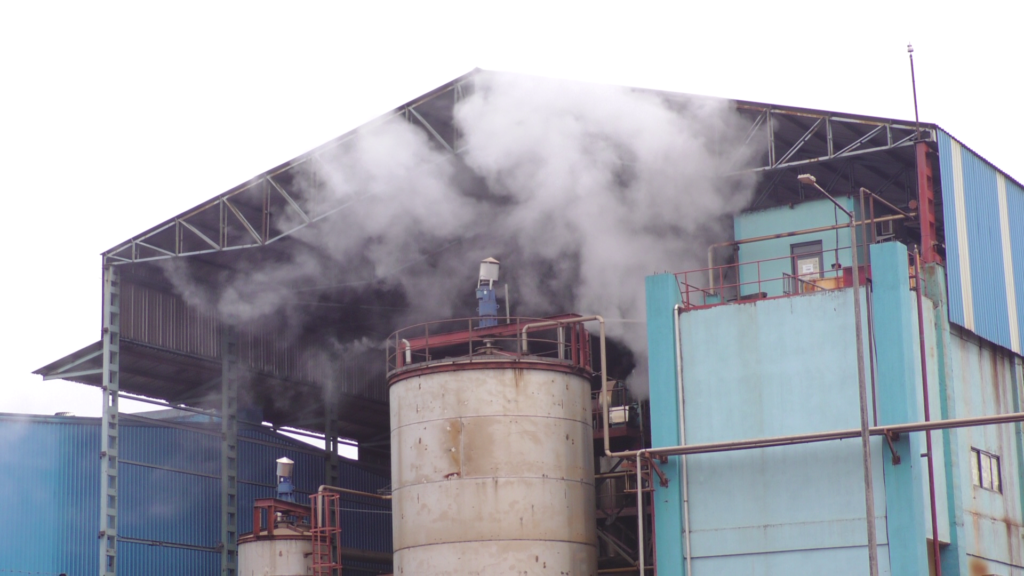
The Ethanol Manufacturing Plant Establishment in Luweero District
Beyond scale and technology, the plant is designed with environmental sustainability at its core. Oswal noted that the factory operates under a Zero Liquid Discharge system, meaning no liquid waste is released into the environment. All effluent is treated and reused within the production cycle.
“This is a fully automated, fully sustainable facility. None of our liquid waste exits into the environment,” she said.
PRO Industries processes about 9,000 metric tonnes of maize every month, sourced largely from Ugandan farmers. The company works directly with farmers and traders, while also partnering with banks to enable contract farming and access to credit.
“Banks are willing to fund farmers who have contracts with us because of our professionalism and scale,” Oswal explained saying this helps farmers improve quality and increases their income.”
The finished ethanol supplies some of the world’s leading beverage companies, including Diageo owner of Johnnie Walker Black Label and Distell, associated with brands such as Heineken in the region. Exports serve markets across East Africa, including Kenya, Rwanda and Tanzania, and extend as far as Scotland.
“One day when someone is sipping Black Label, they’ll remember Uganda Uganda’s grain, Uganda’s soil and Uganda’s potential,” Oswal said.
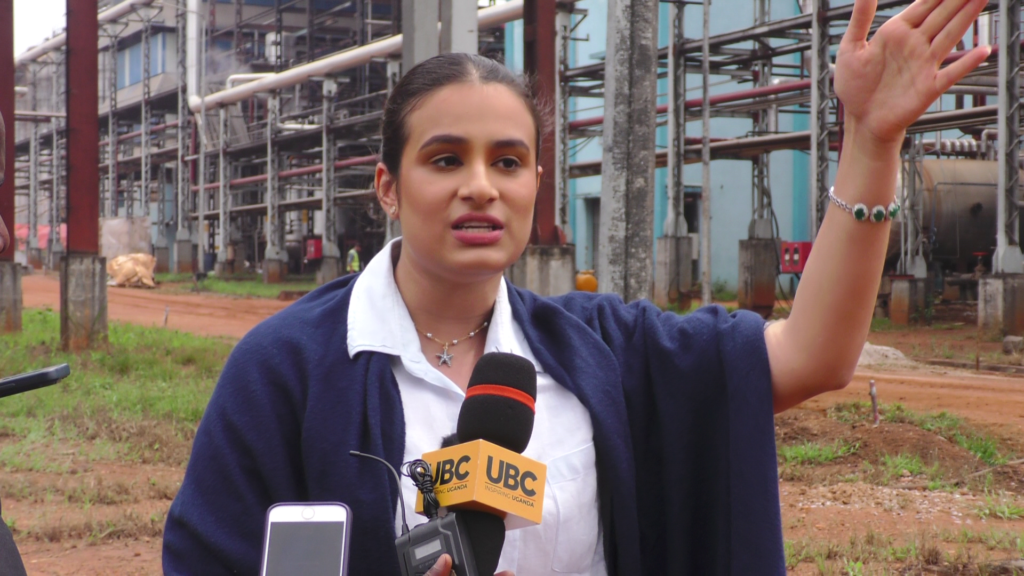
Company’s Director, Riddhi Oswal addresses the Media at the Plant on Tuesday
The USD 100 million investment employs over 500 Ugandans alongside 45 expatriates, combining international expertise with local talent. The company says it remits about USD 500,000 monthly in taxes and statutory contributions to the Uganda Revenue Authority and NSSF.
PRO Industries has also invested in community development in Luwero, including boreholes, training programs and skills development. Ugandan staff are trained to operate advanced industrial control systems, positioning them for long-term careers in high-tech manufacturing.
With an additional 30 acres of land already secured, the company is planning to expand production to 300 kilolitres per day, subject to policy support and investor protection. Oswal said the visit by President Museveni to the plant reinforced confidence in Uganda as a safe destination for industrial investment.
“His Excellency’s visit shows that Uganda values integrity, truth and investors,” she said emphasizing that it gives us the confidence to reinvest and expand.

Company’s Director, Riddhi Oswal explains to the President the activities conducted at the Plant on Tuesday
The company is also preparing to invest in biofuel production, aligning with Uganda’s emerging biofuel and ethanol blending policy, including plans for a 30 KLPD MSDH biofuel plant.
As Uganda seeks to industrialize its agriculture and retain more value within the economy, the Luwero ethanol plant stands out as a practical demonstration of policy in action transforming maize from a raw commodity into a high-value export, creating jobs, earning foreign exchange and positioning the country as a potential continental hub for bio-industrial fuels.
“With the right support, Uganda can become the powerhouse of Africa for bio-ethanol and bio-industrial production,” Oswal said. “The potential is here in our farmers, our raw materials and our people.”
hokurut51@gmail.com, +256700114138
