

By Henry Okurut
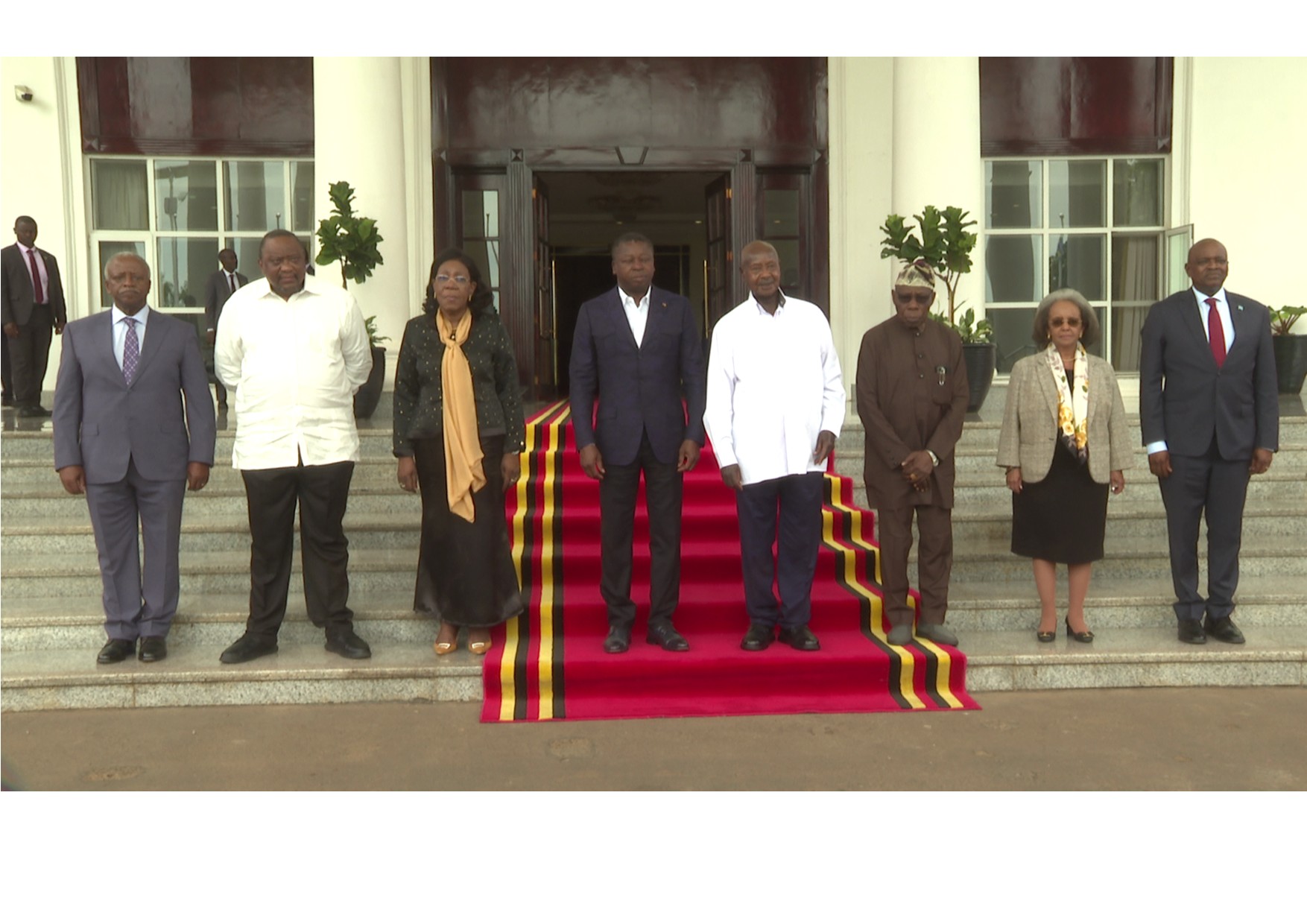
A renewed African-led effort to end decades of instability in the eastern Democratic Republic of Congo (DRC) took centre stage in Uganda on Tuesday as the African Union, East African Community and SADC Panel of Facilitators held high-level talks with President Yoweri Museveni at State House Entebbe.
The delegation, led by President Faure Essozimna Gnassingbé of Togo, formed part of a joint continental and regional initiative aimed at advancing dialogue and forging a comprehensive, African-owned solution to one of the continent’s longest-running conflicts.
Addressing the meeting, former Nigerian President Olusegun Obasanjo, a key member of the facilitation team, said the DRC crisis is neither new nor mysterious, but rooted in long-standing challenges of managing diversity and relations with neighbouring states.
“The issue that brought UN peacekeeping to Congo in 1960 is essentially the same issue we are grappling with today,” Obasanjo said, recalling his first visit to then Congo-Leopoldville more than six decades ago.
He stressed that meaningful progress depends on a shared and honest diagnosis of the problem.
“Once you diagnose a disease properly, it is half solved. But not all of us diagnose the problem the same way, and that has been our challenge,” he noted.
Obasanjo argued strongly for African solutions to African problems, cautioning against overreliance on externally driven peace initiatives.
“Solutions imported from Washington, Qatar or France may not fully address the realities on the ground,” he said, noting that eastern DRC hosts multiple armed groups beyond the M23, alongside unresolved political and social grievances.
The former Nigerian leader said the AU, working closely with the East African Community (EAC) and the Southern African Development Community (SADC), must remain at the centre of the peace process. He welcomed the establishment of a joint AU headquarters in Addis Ababa to coordinate mediation and facilitation efforts.
The panel has already conducted extensive consultations in Kinshasa, Kigali and Bujumbura and engaged with various actors, including leaders of armed groups. Their visit to Uganda, Obasanjo said, was particularly significant.
“President Museveni is in a unique position. He has been involved in this issue longer than anyone else, and nobody we have spoken to has been violently opposed to him,” he said, describing Uganda as a key anchor in the regional peace architecture.
President Museveni, welcoming the delegation, underscored Uganda’s deep familiarity with the Congolese crisis, shaped by geography, history and humanitarian realities.
“We have over 500,000 Congolese refugees here, part of the two million refugees Uganda hosts,” Museveni said, noting that many share ethnic and cultural ties with communities in western and south-western Uganda.
He described the prolonged conflict as both tragic and solvable, pointing out that unlike the 1960s, there are no serious secessionist movements threatening Congo’s territorial integrity today.
“Nobody is talking about breaking up Congo. What we have now are grievances,” Museveni said, calling it an opportunity for Kinshasa to address underlying concerns through dialogue rather than force.
The Ugandan leader expressed readiness to work closely with the AU-led mediation team, saying regional actors must shoulder responsibility while carefully managing the interests of external partners.
The Entebbe meeting reinforced growing consensus that peace in eastern DRC will require inclusive dialogue, regional cooperation and sustained African leadership, addressing not only armed groups but also the deeper political, social and economic drivers of conflict.
For the facilitators, the visit marked another step in a long journey one Obasanjo hopes will finally bring closure to a crisis that has spanned generations.
“I hope before I die, this problem will be solved,” he said.
hokurut51@gmail.com, +256700114138
